
“That Brooch Belonged to My Dead Daughter!” the Billionaire Shouted at the Waitress… But the Hidden Engraving Inside the Jewelry Exposed a Family Sin Buried for Decades
The entire dining room at The Silver Swan went silent the moment Eleanor Whitmore’s voice cut through the restaurant.
It was not the kind of silence that comes from respect. It was sharper than that. It was the silence of rich people pausing mid-sip because something ugly had interrupted their perfect evening, and they were too curious to look away.
Crystal glasses stopped halfway to painted lips. A senator at the corner table lowered his fork. A tech CEO sitting near the window turned his head slowly, as if a scandal had just been placed on the menu. Even the pianist near the bar missed a note, then pretended he had meant to.
The Silver Swan sat on the fifty-second floor of a glass tower in Manhattan, with windows that showed the city glittering beneath it like a jewelry box. It was the kind of place where the napkins were folded like art, the steak cost two hundred dollars, and the guests did not ask prices because asking meant you were not supposed to be there.
Lena Morales was very aware that she was not supposed to be there as anything more than staff.
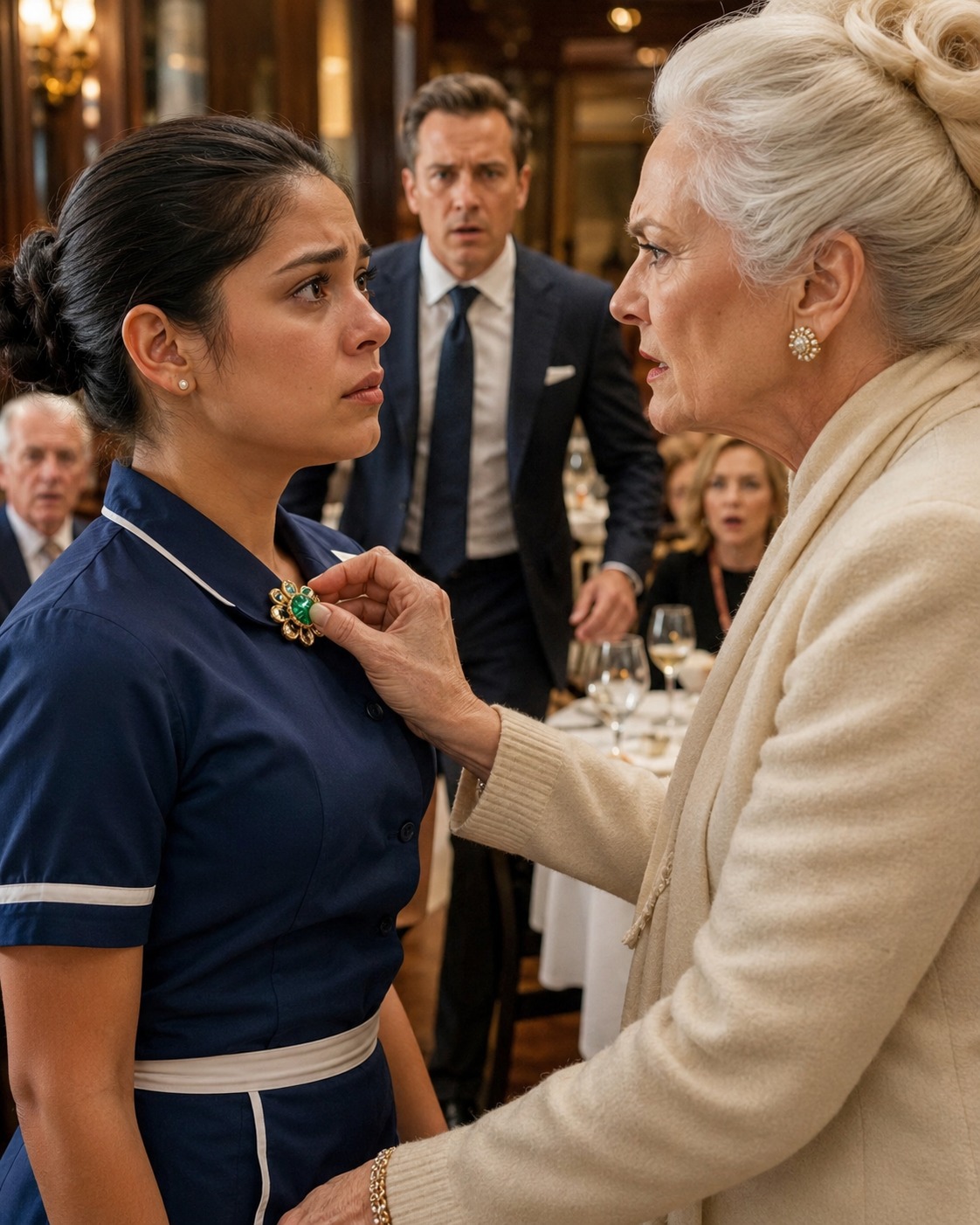
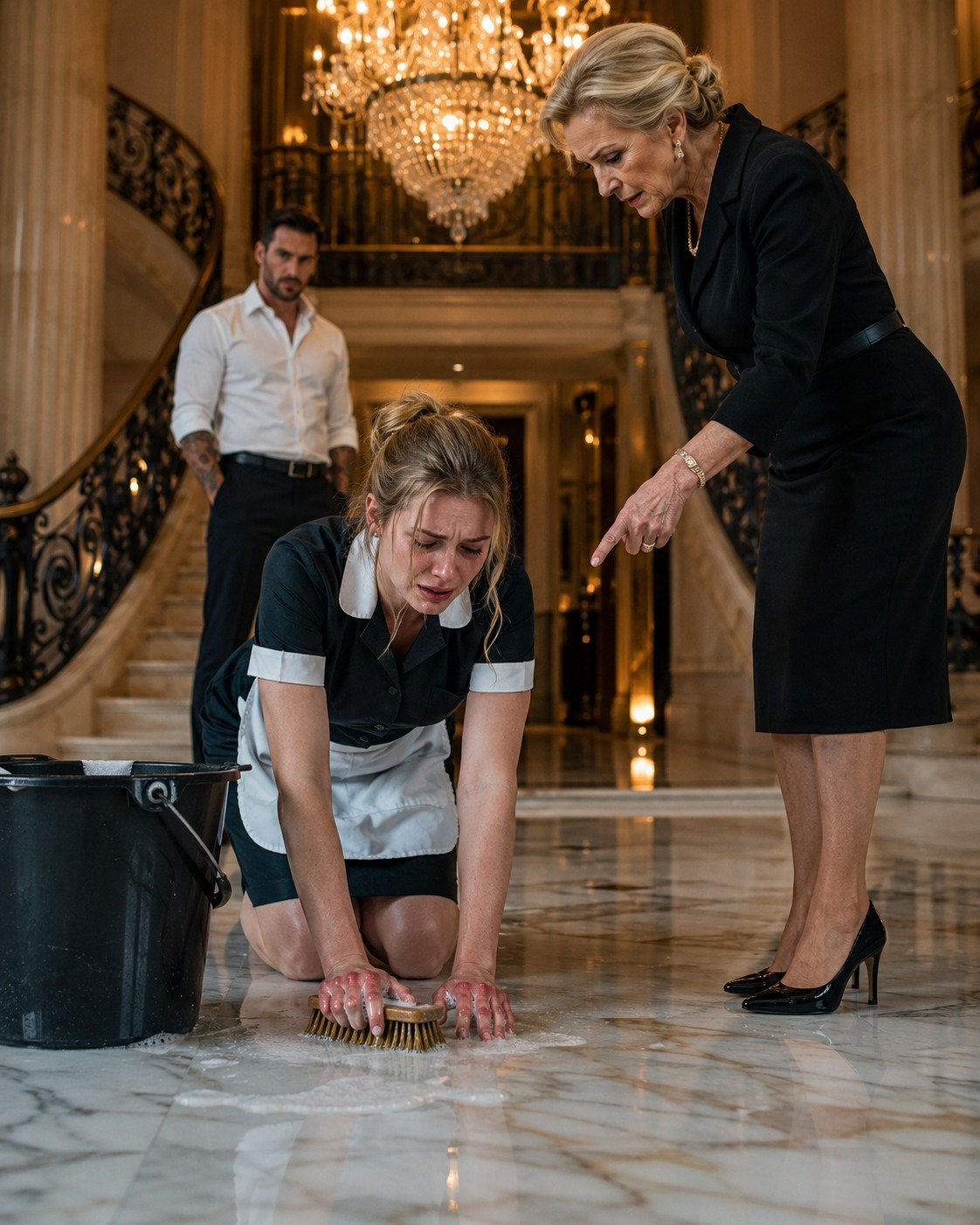
She was twenty-four, wearing a fitted black waitress uniform, carrying two plates of truffle risotto that smelled more expensive than her weekly groceries. Three minutes earlier, her biggest worry had been whether her tips would cover the overdue electric bill in her tiny apartment in Queens. Now, one of the most powerful women in New York had her fingers wrapped around the collar of Lena’s uniform.
The tug was not strong enough to hurt badly.
That made it worse.
It was controlled. Deliberate. The kind of small violence only someone untouchable uses when she knows the other person cannot fight back.
Lena turned and found herself face-to-face with Eleanor Whitmore.
Everyone in the city knew that name. Eleanor was seventy-two, a billionaire hotel heiress, a widow twice over, and the kind of woman whose family foundation had its name on hospital wings, university buildings, and museum galleries. Her white hair was pulled into a perfect twist. Her emerald silk jacket looked soft enough to sleep on and expensive enough to pay six months of Lena’s rent. Her posture was regal. Her eyes were not.
Her eyes were fixed on the small gold brooch pinned near Lena’s collar.
It was shaped like a flower, with a deep green stone in the center. Lena had worn it every shift since her grandmother died, not because it matched the uniform, but because it was the only piece of family she had left that felt alive when she touched it.
Eleanor’s face had gone pale beneath her flawless makeup.
“That brooch,” she said, her voice dropping so low it frightened Lena more than the shout had. “Where did you get it?”
Lena swallowed. “Ma’am?”
“Do not play stupid with me.” Eleanor’s fingers tightened around the fabric. “That brooch belonged to my daughter.”
A murmur moved through the dining room.
Lena felt heat rise up her neck. “I’m sorry, but that isn’t possible. It was my grandmother’s. She gave it to me before she passed.”
“Your grandmother?” Eleanor repeated the words as if they tasted dirty. “A girl like you does not inherit Whitmore jewelry.”
The sentence landed harder than a slap.
A girl like you.
Lena knew what that meant. She had heard different versions of it all her life, sometimes spoken plainly, sometimes wrapped in politeness. A girl from a walk-up apartment. A girl who took the subway home after midnight. A girl whose hands smelled like lemon cleaner and coffee because she worked double shifts to keep from drowning.
“My grandmother’s name was Rosa Morales,” Lena said, forcing herself to keep her voice steady. “She raised me. She told me this brooch was hers.”
Eleanor laughed once, cold and humorless.
“That brooch disappeared the year my daughter died,” she said. “My daughter, Isabel Whitmore. Twenty-seven years old. Brilliant. Beautiful. Gone before she had a chance to live. And now a waitress is standing in front of me wearing the last piece of jewelry she ever owned.”
The restaurant seemed to lean closer.
Lena could feel every stare. The guests did not see a young woman being cornered. They saw entertainment wearing an apron.
“I didn’t steal anything,” Lena whispered.
Eleanor’s mouth tightened. “Then explain how a family heirloom worth more than your entire life ended up on your uniform.”
A server named Marcus stepped forward quickly and took the risotto plates from Lena’s shaking hands before they fell. His face was tense, but he did not speak. Everyone who worked at The Silver Swan understood the rule: when people with names on buildings made accusations, people with name tags paid the price.
From across the dining room, Adrian Whitmore entered through the private elevator.
At forty-five, Adrian had inherited his father’s broad shoulders, his mother’s sharp cheekbones, and the tired expression of a man born into too much money and too many secrets. He had come for a business dinner, but the moment he saw his mother standing in the center of the restaurant with her hand on a terrified waitress, his face hardened.
“Mother,” he said, his voice cutting through the room. “What are you doing?”
Eleanor did not look away from Lena.
“What I should have done years ago,” she said. “This girl is wearing Isabel’s brooch.”
Adrian stopped.
For the first time, Lena saw something other than authority in his face.
Pain.
Real pain.
His eyes moved to the brooch, and for one brief second, the whole room seemed to disappear from him.
“That’s impossible,” he said quietly.
“Is it?” Eleanor snapped. “It vanished after the accident. We all knew someone had taken it. And now here it is, pinned to the collar of a waitress who claims her grandmother gave it to her.”
The owner of the restaurant, Charles Bennett, hurried over with the anxious smile of a man watching disaster walk toward his reputation. He dabbed at his forehead with a linen napkin.
“Mrs. Whitmore, I’m sure there’s a misunderstanding. Perhaps we can step into the private room and—”
“I will not step anywhere,” Eleanor said. “Call security. Then call the police. I want her searched, questioned, and arrested.”
Lena’s stomach dropped.
“Arrested?” she said.
“For theft,” Eleanor replied. “And if you lie again, I will make sure every employer in this city knows your name.”
Lena looked around the room, hoping someone would speak. No one did. The senator studied his wine. The CEO pretended to check his phone. A woman in diamonds leaned toward her friend and whispered something behind her hand.
Adrian took a step forward. “Mother, enough.”
But Eleanor lifted one finger without turning. “Do not defend her. Not before I know how she got something that belonged to your sister.”
The word sister changed Adrian’s face again.
Lena saw the grief there. She saw how old it was. How carefully polished. How dangerous it could become in the wrong hands.
Her own fear shifted into something else.
Not courage exactly.
Exhaustion.
She was tired of being handled. Tired of being measured by her uniform. Tired of rich people believing they could turn another person’s life into ashes because their voices carried farther.
With trembling fingers, Lena reached for the brooch.
The room held its breath.
“That Brooch Belonged to My Dead Daughter!” the Billionaire Shouted at the Waitress… But the Hidden Engraving Inside the Jewelry Exposed a Family Sin Buried for Decades



Leave a Reply