
My Husband Bragged About the Bruises on My Neck—Until My Uncle Took Off His Hearing Aids
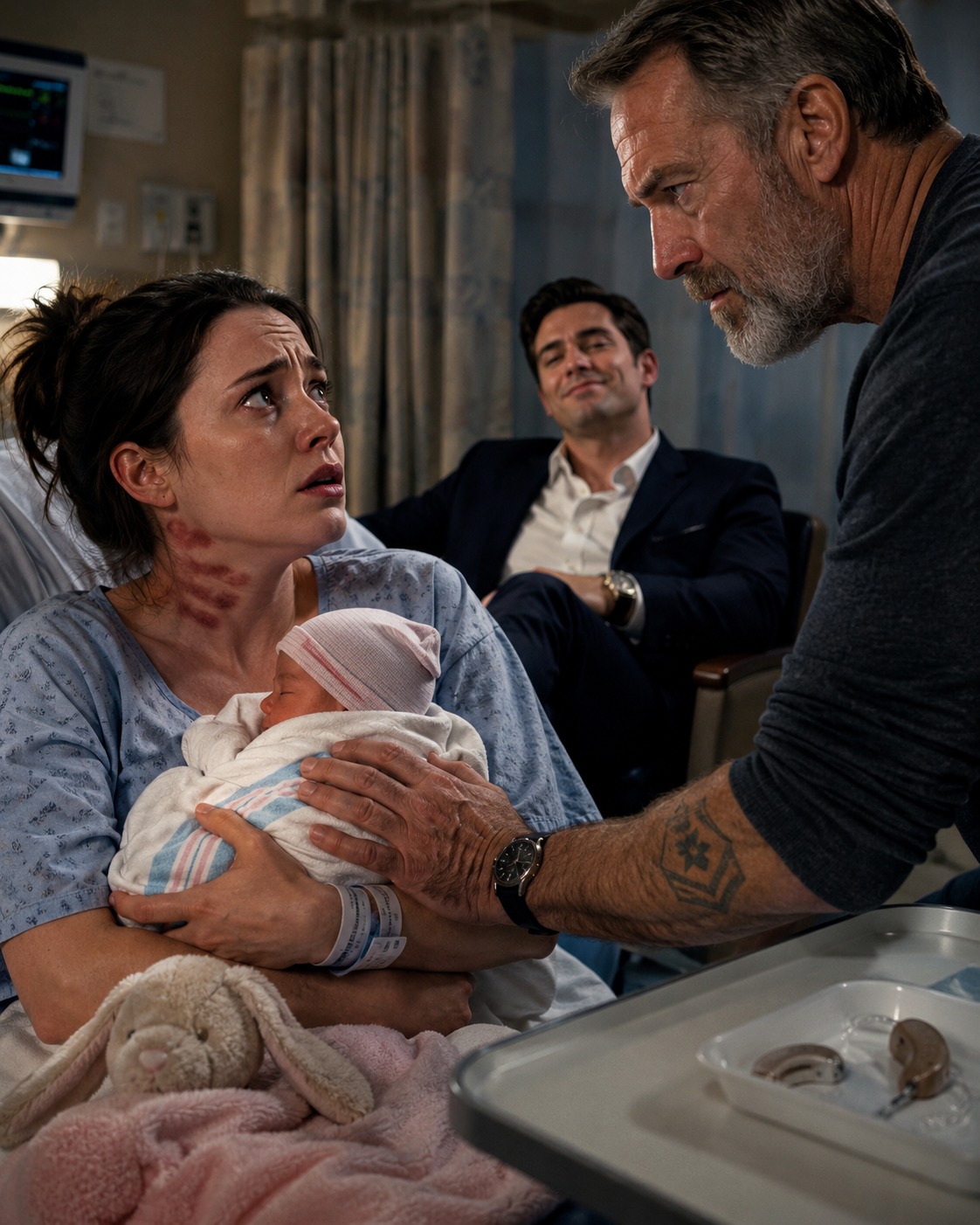
I was holding my newborn daughter when my uncle walked into the hospital room and saw the dark fingerprints around my throat. My husband leaned back in the visitor chair, smiling like he had done something clever.
“Just teaching her who runs this family now,” Brandon said.
My uncle didn’t raise his voice. He didn’t rush across the room. He simply closed the hospital curtains, removed his hearing aids, and placed them carefully on the metal tray beside my bed.
Then he looked at me with the same calm voice he used when I was a frightened little girl.
“Close your eyes, sweetheart.”
That was when my father-in-law noticed the faded military tattoo on my uncle’s forearm. His face turned gray, his expensive posture collapsed, and he suddenly bent over and vomited into the hospital trash can.
That was the moment I realized Brandon had not just hurt the wrong woman.
He had challenged the wrong family.
Six hours earlier, I had given birth to my daughter, Emma, after nineteen hours of labor in a private maternity room at a hospital just outside Boston. My body was shaking from exhaustion, my hair was damp against my face, and my arms were wrapped around the tiny person I had spent nine months protecting.
Brandon had spent most of the delivery complaining about the coffee, the parking garage, and how long everything was taking.
His mother had taken one look at Emma and said, “At least she inherited the Whitmore features.”
No one asked if I was okay.
No one asked if I needed water.
No one cared that my hands were still trembling as I tried to hold my daughter without crying.
Then Brandon leaned close enough that only I could hear him and whispered, “The house is mine. The accounts are mine. The baby is mine. You’re going to learn your place fast.”
When I told him Uncle Jack was coming, he laughed.
“That deaf old mechanic?” he said. “Perfect. Let him watch you finally behave.”
Uncle Jack was not my father by blood, but he was the only father I had ever known. After my parents died in a crash outside Worcester when I was nine, he took me in without hesitation. He was the man who packed my school lunches, fixed my first car, taught me how to change a tire, balance a checkbook, read a contract, and stay quiet when dangerous men were trying to make me panic.
Most people saw his worn flannel shirts, oil-stained hands, and hearing aids.
They never looked long enough to see what kind of man stood behind them.
When Jack entered my hospital room, he carried a small pink gift bag and a stuffed rabbit for Emma. For one beautiful second, his eyes softened.
“She’s perfect,” he whispered.
Brandon snorted from the chair.
“Careful,” he said. “We don’t let grease monkeys touch family property.”
The room went still.
I lowered my eyes, not because I was broken, and not because I was afraid. I lowered them because the tiny camera hidden inside Emma’s stuffed bunny was pointed directly at Brandon’s chair.
Three months earlier, after Brandon shoved me into the pantry door hard enough to split my lip, something inside me changed. I stopped begging him to become the man he pretended to be in public.
I started building a file.
Photos. Emergency room records. Voice recordings. Screenshots. Bank transfers. Text messages from his father about “keeping the girl under control.” Emails from the Whitmore family attorney offering me money if I signed away custody before Emma was born.
Every threat.
Every bruise.
Every dollar they tried to use against me.
I copied everything and sent it to a domestic violence advocate, a detective, and one retired judge who owed Uncle Jack a favor from a war no one in our family ever spoke about at dinner.
So when Brandon smiled at my uncle and bragged about the marks on my neck, he had no idea the room was already listening.
Uncle Jack walked to my bedside first. He touched Emma’s blanket with two fingers, gentle as a prayer.
“She looks like your mother,” he said.
For the first time that day, tears burned behind my eyes.
Brandon rolled his eyes. “This is touching, but Claire needs to understand something. She’s a Whitmore now. That baby is a Whitmore. And in this family, we handle women who get dramatic.”
Charles Whitmore, Brandon’s father, stood near the window in a tailored navy suit that probably cost more than my first car. He did not look shocked. He did not look ashamed. He looked annoyed that Brandon had said too much in front of a visitor.
“Enough,” Charles said sharply. “This can be settled privately.”
Uncle Jack turned toward him.
That was when the sleeve of his shirt shifted.
The old tattoo appeared on his forearm, faded by time but still unmistakable to someone who knew what it meant.
Charles saw it.
And everything about him changed.
The color drained from his face. His hand flew to the wall as if the room had tilted. His polished shoes scraped against the hospital floor, and then the great Charles Whitmore—millionaire developer, respected donor, untouchable family patriarch—doubled over and vomited into the trash can.
Brandon finally stopped smiling.
“What the hell is wrong with you?” he snapped at his father.
But Charles couldn’t answer. He was staring at Jack like a ghost from his worst memory had just walked through the door wearing work boots.
Uncle Jack calmly closed the curtains. Then he removed both hearing aids and placed them on the tray beside my bed.
I knew what that meant.
He did not want excuses.
He did not want pleas.
He did not want to hear another lie.
He looked at me one last time.
“Close your eyes, sweetheart,” he said softly.
I pulled Emma closer to my chest and did exactly what he told me.
Because for the first time in months, I knew I was not alone.
And Brandon Whitmore was about to learn that some women do not break quietly.
They collect proof.
My Husband Bragged About the Bruises on My Neck—Until My Uncle Took Off His Hearing Aids






Leave a Reply