
On My 70th Birthday, My Son Served Me Dog Food in My Own House… Not Knowing I Had Kept Every Receipt That Would Destroy His Lies
PART 1
Mr. Arthur Salcedo turned seventy on a gray Saturday morning in a quiet neighborhood in Pasadena, California.
He woke up before sunrise, before the first delivery truck rolled down the street, and tied on the faded blue apron his late wife, Rose, had given him years ago when they were still young enough to laugh at bills, back pain, and the strange little punishments life throws at ordinary people.
Rose had been gone for eight years.
Since then, Arthur had lived in the same modest two-story house they bought together after thirty-four years of running a small auto parts store outside Los Angeles. It was not a mansion. It did not have marble floors or ocean views. But it had walls full of memories, a bougainvillea climbing near the porch, and a wooden dining table where Rose had served chicken soup to anyone who showed up sad, hungry, or too proud to ask for help.
His only son, Julian, lived there too.
According to Julian, it was temporary.
Temporary was when he arrived with two suitcases and a maxed-out credit card.
Temporary was when he lost his sales job and promised he only needed “a couple of months to reset.”
Temporary was when he moved in his girlfriend, Brenda, a woman with long glossy nails, expensive perfume, and a laugh that always sounded like it had been practiced in front of a mirror.
Temporary had lasted four years.
Julian was thirty-eight, full of business quotes, motivational podcasts, and big plans that never survived past lunch. He had no steady income, no discipline, and an incredible talent for making his father feel guilty whenever Arthur asked when he planned to help with the mortgage, utilities, groceries, or anything else adults usually pay for when they live under someone else’s roof.
Brenda did not work either.
She claimed she did “social media consulting,” though the only thing Arthur ever saw her post were photos from restaurants, nail salons, and weekend trips paid for with the extra credit card Julian had talked Arthur into adding him to.
That Saturday, Arthur cooked for his own birthday.
He made pot roast the way Rose used to like it, mashed potatoes with too much butter, green beans, cornbread, and a chocolate cake from the bakery where Rose used to buy Sunday pastries after church. He even set aside the good plates because, at seventy, a man is allowed to hope that his son might sit across from him and say one honest sentence.
Thank you, Dad.
Happy birthday.
You did enough.
Anything.
While the roast cooked, Arthur imagined a small dinner. Julian sitting at the table without checking his phone. Brenda at least pretending to be respectful. Maybe a call from his granddaughter Sophie, whom he barely saw anymore since Brenda started deciding which family members were “healthy for their image.”
He did not want a party.
He did not want gifts.
He only wanted not to feel like a burden in the house he had paid for with his own hands.
After noon, Arthur went upstairs to rest. His knees ached, and there was a heaviness in his chest that had become familiar over the years, the kind of loneliness that gets louder on birthdays. He sat on the edge of the bed, looked at Rose’s framed photograph on the nightstand, and said softly, “I tried, Rosie.”
Then he fell asleep.
When he woke, the room was dark.
Music thumped downstairs.
People were laughing.
Glasses clinked.
Arthur pushed himself up slowly and made his way down the stairs, holding the railing Rose had once sanded and stained herself during a summer when they could not afford to hire anyone. Halfway down, he smelled the pot roast, the warm bread, the chocolate cake.
Then he reached the dining room and stopped.
There were more than twenty people in his house.
Brenda’s cousins.
Julian’s friends.
Neighbors who only came around when there was free food.
People Arthur barely knew.
They were eating his roast, his potatoes, his cornbread, his cake.
No one had called him down.
At the head of the table sat Julian.
In Arthur’s chair.
And Brenda sat in Rose’s old seat, legs crossed, laughing with a glass of wine in her hand as if she had been born into that house and Arthur was the guest who arrived too late.
Arthur tried to smile.
“You all started without me?”
The silence lasted less than a second.
Julian burst out laughing.
“Oh, come on, Dad,” he said. “We didn’t even realize you were still upstairs. Lately you move around here like a ghost.”
A few people laughed.
Others looked down at their plates.
Arthur swallowed the sting in his throat.
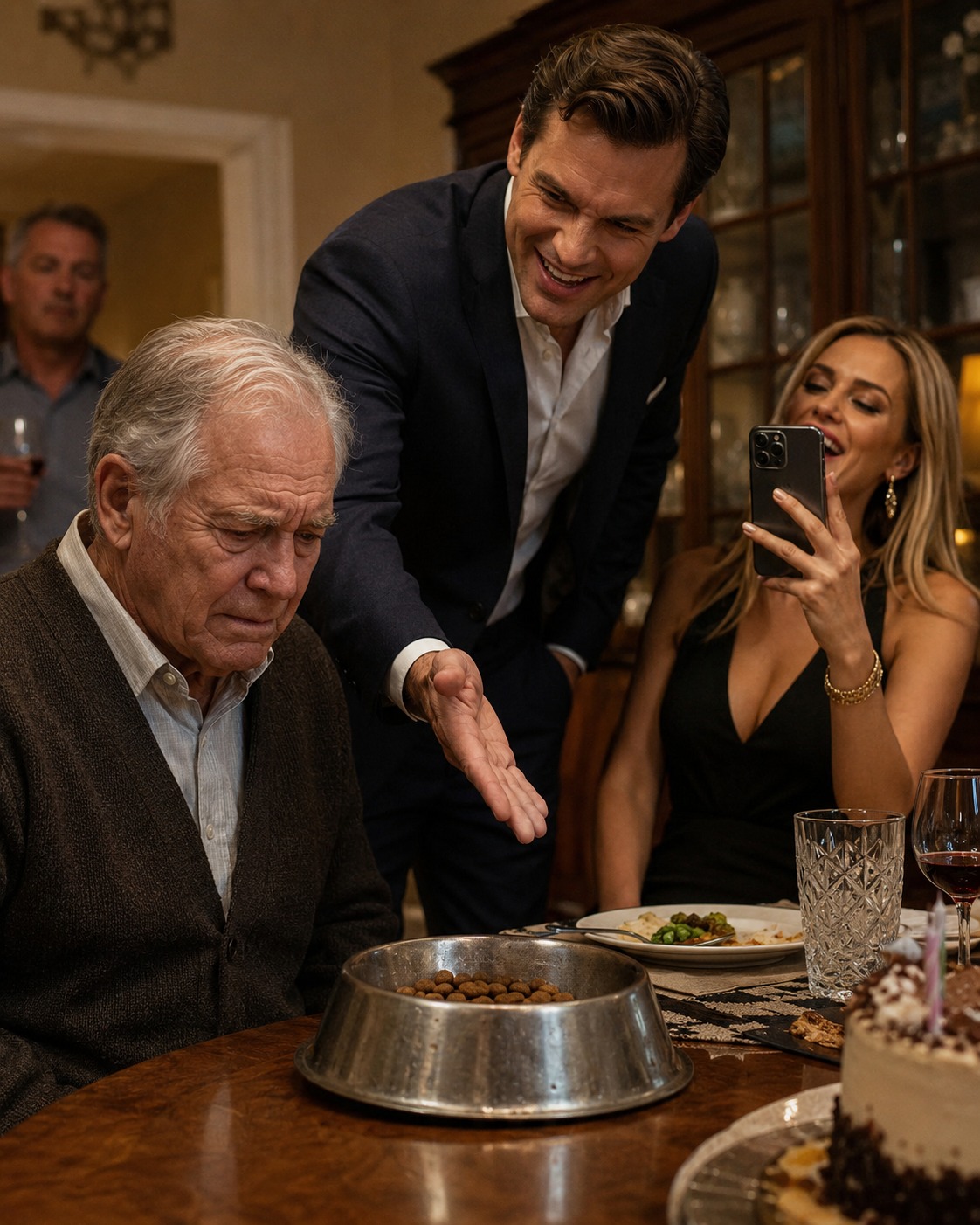
Then Julian stood, walked into the kitchen, and came back carrying an old metal bowl.
Arthur recognized it immediately.
It had belonged to Captain, the dog Rose had rescued from a parking lot years earlier, the same dog now buried beneath the bougainvillea near the porch.
Julian opened a bag of dry dog food, poured it into the bowl, and set it in front of his father.
“There you go, old man,” he said. “Dinner for the one living here rent-free.”
The room froze.
Arthur looked at the bowl.
Then at his son.
Brenda pulled out her phone and started recording.
“Don’t get all sensitive, Mr. Salcedo,” she said with a smile. “It’s a joke. Besides, Julian has a point. You don’t pay rent here.”
In the house Arthur had bought.
With the money he had earned.
At the table where Rose used to bow her head before every meal.
On his seventieth birthday.
Something cracked inside Arthur, but it made no sound.
He did not shout.
He did not cry.
He did not throw the bowl.
He picked it up with both hands, walked to the front door, and placed it outside beside the bougainvillea, exactly where Captain used to sit in the sun.
When Arthur came back inside, everyone watched him, waiting for an outburst.
But he only said, “Enjoy the dinner.”
Then he turned and went upstairs.
Behind him, Julian called out, loud enough for the room to hear, “All right, everybody, keep eating. Tonight’s on me.”
That was a lie.
Everything was on Arthur.
The food.
The electricity.
The gas.
The internet.
Julian’s car insurance.
Brenda’s nails.
The “emergency expenses” that always turned into online shopping, restaurant bills, and weekend hotel charges.
Arthur closed his bedroom door and locked it for the first time in years.
Then he opened his laptop.
Before he ever owned an auto parts store, before retirement softened his hands but not his mind, Arthur had been an accountant. Forty-two years of numbers had taught him something important: people lie with their mouths, but money leaves footprints.
And old accountants do not forget.
They keep receipts.
Contracts.
Bank statements.
Screenshots.
Credit card records.
Transfer confirmations.
Every excuse with a date.
Every lie with a dollar amount.
While laughter continued downstairs and strangers finished the birthday dinner he had cooked for himself, Arthur opened a folder on his computer and began adding everything up.
The mortgage payments Julian claimed he helped with.
The utility bills he never touched.
On My 70th Birthday, My Son Served Me Dog Food in My Own House… Not Knowing I Had Kept Every Receipt That Would Destroy His Lies






Leave a Reply